What Makes Influ2 Different From Traditional Digital Advertising


Imagine hiring a headhunter to find your next CMO, and then evaluating their performance based on how many résumés they gave you. You hired them to find one specific person, not to get as many applicants as possible.
In the world of B2B advertising, think of Influ2 as the headhunter. Influ2 is a contact-level ABM platform built to reach specific people at target accounts, not just anyone who matches a job title. Traditional digital advertising (e.g., running campaigns directly on LinkedIn, search ads, display ads, etc.) is more like posting a public job listing and hoping the best candidates see it.
Both can be effective, but they’re two different playbooks. One is focused on precision (Influ2), and the other on volume (traditional advertising).
| Traditional B2B advertising | Influ2 | |
| Primary objective | Volume and lead generation | Engaging specific people at target accounts for ABM |
| Who you're reaching | Anonymous people based on demographics and account lists | Specified named contacts your sales team wants to convert |
| Optimization model | Optimizes for engagement probability (ads go to people most likely to click) | Optimizes for precision (ads go specifically to the people you want to convert) |
| What an impression tells you | Someone in your target segment saw the ad, but you don't know who | Exactly who saw your ad and what account they belong to |
| What a click tells you | An anonymous visitor clicked your ad | Who clicked your ad, which ad, and when, giving you insight into what each person cares about |
| How success is measured | CPM, CPC, CPL, form fill rate | Which named contacts moved through opportunities after engaging with your ads, and how their conversion rate compares to those who haven't |
| Where it fits in go-to-market | Brand building, demand generation, top-of-funnel | Full funnel (pipeline generation, progression, and expansion/retention) |
The precision playbook: What Influ2 is built to do
Influ2 takes a focused and highly targeted approach to engaging the buyers you care about. You have a list of contacts (the same people your sales team is actively pursuing), and the goal is to reach those specific people and surface actionable signals when they engage or show interest, and to answer questions like:
- Did the decision maker at my account—Jane, the VP of Finance—see my ad?
- Which message resonated with them (i.e., did they click the ad)?
- Are my prospects currently researching the types of products I’m trying to sell them?
- Did my SDR get notified when action was detected so they can reach out while interest is still top of mind?
Because the goal is precision, Influ2 optimizes for reach of your selected contacts, not engagement probability. If a CTO at your target account has never clicked on an ad or filled out a form in their professional life, Influ2 will still serve them ads because you've identified them as someone who matters. But, if you were running the same campaign directly through LinkedIn, that CTO might be deprioritized depending on the goal you set, and you'd have no way of knowing.
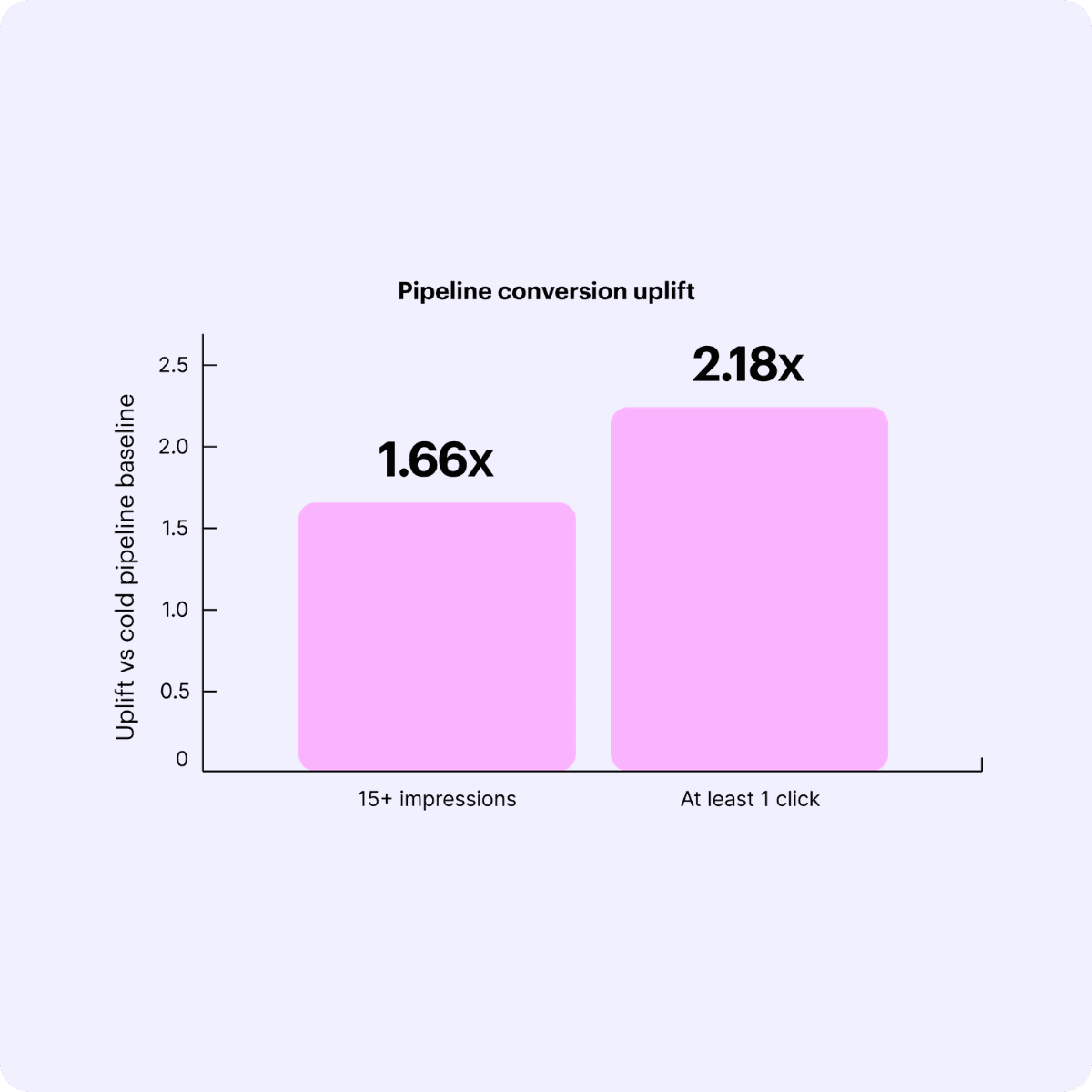
That precision has a measurable lift on conversion rates. Earlier this year, we analyzed 2 million targets, grouped by their level of ad exposure:
- Those with no ad exposure
- Those who saw ads repeatedly (15+ impressions)
- Those who clicked an ad at least once
We found when buying group members had consistent ad exposure (15+ impressions) pipeline conversion was 1.66x higher than an audience with no ad exposure. And when they showed active engagement (at least one click), pipeline conversion was 2.18x higher.
Influ2 also layers in contact-level intent, which tracks when buyers are:
- Searching for relevant keywords—even if they never click
- Reading related content across third-party websites
- Posting about key topics on social media
When intent is detected, you’ll know exactly who engaged, where, when, and the topic they’re interested in—so you have every detail you need to act on it.
Combined with ad engagement, you get a complete picture of what each targeted person is interested in, which makes outreach warmer and more relevant.
The volume playbook: What traditional B2B advertising is built to do
Traditional B2B advertising is the right approach for a specific and legitimate objective: generating awareness and capturing demand at scale. The game is volume: Brand awareness, demand generation, top-of-funnel reach, and hand-raisers who fill out forms.
As a result, traditional ad platforms optimize delivery based on those objectives. LinkedIn’s support article makes this clear:
An objective is the goal you’d like to achieve with your ad set. Ad sets are optimized for delivery to people most likely to take the action you want based on the objective you select. Each objective offers ad formats and bidding strategies that align with the goals of that objective.
But the people most likely to click an ad aren't always the people your team needs to reach, particularly in larger, complex deals.
A click might belong to the CFO or an intern doing competitive research, and the platform won't tell you which. That's par for the course when the goal is volume, but it's a structural problem when you need to convert specific stakeholders.
Why CPC and CPM aren’t the right metrics when your goal is precision
With traditional B2B advertising, CPM and CPC make sense because they measure what that approach is designed to produce: volume of impressions and traffic, with the hope that enough of the right people are in the mix. Since platforms like LinkedIn and Meta don’t tell you who your ads reach, volume is the only lever they can measure and optimize.
However, CPM and CPC don’t account for the information that makes a click or impression actionable:
- Who it belonged to
- Whether that person was someone you needed to reach
- Whether Sales can do anything with it
At their core, CPM and CPC are efficiency metrics that measure how cheaply you're buying reach and traffic. Henry Innis, co-founder of Mutinex, made the case in a piece about why CPM is the wrong metric for most campaigns:
CPM is a metric of efficiency. It tells you, in theory, how cost-effectively you are reaching an audience. But efficiency is worthless if it’s not effective. You can efficiently buy a million impressions for $10, but if those impressions are served to bots in a server farm in Siberia or stacked invisibly behind 15 other ads on a pirated movie site, your "efficient" campaign has been 100% ineffective. You’ve efficiently set your money on fire.
Since Influ2’s playbook is about reaching specific people to increase their likelihood of converting, not just getting as many clicks or form-fills as possible (regardless of whether they’re from people you want to reach), CPM and CPC aren’t the metrics that matter. Instead, Influ2 measures what actually matters: whether your ads reached the right people, and whether that exposure influenced pipeline and revenue.
Which approach fits your objective? (it's not always either/or)
The deciding question is whether you're trying to build a list of leads or reach people you've already identified as the ones who matter. Volume motions cast wide, capture hand-raisers, and generate form fills from people who may or may not be the right fit. The precision motion (Influ2) runs against a named list, produces and gathers contact-level signals, and gives your salespeople something they can actually act on.
If traditional advertising is fully delivering what you need (awareness, lead volume, qualified pipeline), it's doing the job it was designed for. Keep running it. The two don't have to compete.
Traditional advertising handles brand awareness and demand generation at scale, while Influ2 gives you the precision to build awareness with specific contacts, move open opportunities forward, and feed Sales more actionable contact-level signals. Running both is how a lot of mature GTM teams are structured (including ours).
If you'd like to see what a contact-level ABM motion looks like in practice, we'd love to show you.

Roman is a Senior PPC Specialist at Influ2, leading the paid program. An engineer, Roman is happiest designing reliable systems that turn ad spend into predictable performance. He was a believer in contact-based advertising long before joining Influ2 - and now gets to put that conviction to work every day.

