Why "Good" Ad Metrics Still Can't Justify Your ABM Budget


"What's the ROI?" The VP of Finance asked it the way you'd ask about the weather. Steve Armenti, an ABM leader who's built programs at companies including Google, froze. He'd put $200K behind a campaign that quarter, pipeline was up $1.2M, and he had no way to prove the two were connected.
So he mumbled something about upper-funnel influence and brand lift. (Most of us have reached for that exact sentence at least once.)
The reason he froze is a structural issue that a lot of teams struggle with. Their tools stop at the account level.
Account-level ad reporting can tell you an account was active, but not whether your ads reached anyone actually connected to a deal. All your charts can go up and to the right, but unless you can name the people your ads reached, "influenced pipeline" is just an inference.
That gap is fixable, and I’ll explain how. But first, it's worth being honest about how wide it really is.
Healthy ad metrics don't survive the budget conversation
Your click-through rate is fine, impressions are up, and your ABM tool says you've engaged your target accounts. Yet, none of it answers the only question leadership actually asks.
Nick Bennett, a B2B marketing operator who writes about ABM and demand gen, described the moment it caught up with him in a board meeting. The CEO pulled up the marketing dashboard, scrolled, and asked the obvious thing.
"Pages and pages of green arrows pointing up. 'Great,' he said. 'So why is revenue flat?' The room went silent."
The dashboard was full of data, but not one number on it could answer that question.
The problem underneath it is simple.
Your ads reached people at target accounts and opportunities opened at those accounts. But nothing ties the two together. That disconnect is the whole issue, and it's not something you can solve by changing numbers in a dashboard.
Account-level reporting can only tell you an account was busy
Traditional ABM platforms aggregate engagement at the company level, which means "influenced pipeline" is really just a guess about which specific person your ad reached. Most enterprise ABM tools work the same way:
- Pick a company
- Buy impressions across that company's IP range or cookie pool
- Report back on company-level activity
That design is why marketers default to activity metrics in the first place.
We partnered with Forrester on a report about contact-level ABM and found engagement metrics like opens and content downloads were the number-one category teams used to measure effectiveness, largely because they can only track what their tools capture.
That leaves a lot of marketers exposed the moment someone asks for proof.
Peep Laja, CEO of Wynter, surveyed 50 B2B marketing leaders and found 58% were under extreme or high pressure to show pipeline results, with most unable to prove what was actually working. His diagnosis is blunt.
You can't pinpoint which one 'caused' the deal. That's fantasy. But leadership demands certainty. So you build dashboards that give them lies dressed up as data.
To be fair, those legacy ABM platforms are trying to reach the right people. They just can't isolate and confirm which specific individuals saw or engaged with your ads, so the influence they report is really just an assumption.
If you want the mechanics of how these models attribute pipeline, we've covered them in our guide to how ABM attribution works and what marketing-influenced revenue actually measures.
To prove your ads worked, you have to know who saw them
Contact-level reporting closes the gap by showing exactly which named people saw and clicked your ads, so you can connect ad engagement to the actual humans on the deal. That turns inferred influence into verified influence.
Instead of "someone at Acme engaged," you can see that Acme's VP of Finance saw the ad 20 times, clicked twice, and that she's a contact in a newly opened opportunity. Influ2 is the contact-level ABM platform that makes that possible:
- Add the people you want to reach to Influ2 (can be synced from your CRM)
- Serve ads to those specific individuals across the channels they already use (LinkedIn, Instagram, Facebook, Google, Bing, and more)
- See exactly who saw and clicked each ad at the contact level, and automatically push those signals to sales
Influenced-vs-cold conversion is the number that ends the budget argument
Once ad influence is tied to named contacts, one data point settles the budget question: do accounts your ads actually reached convert better than the ones they didn't?
Influ2 gives you that answer by comparing ad-influenced conversions vs. cold conversions.
The mechanic is simple.
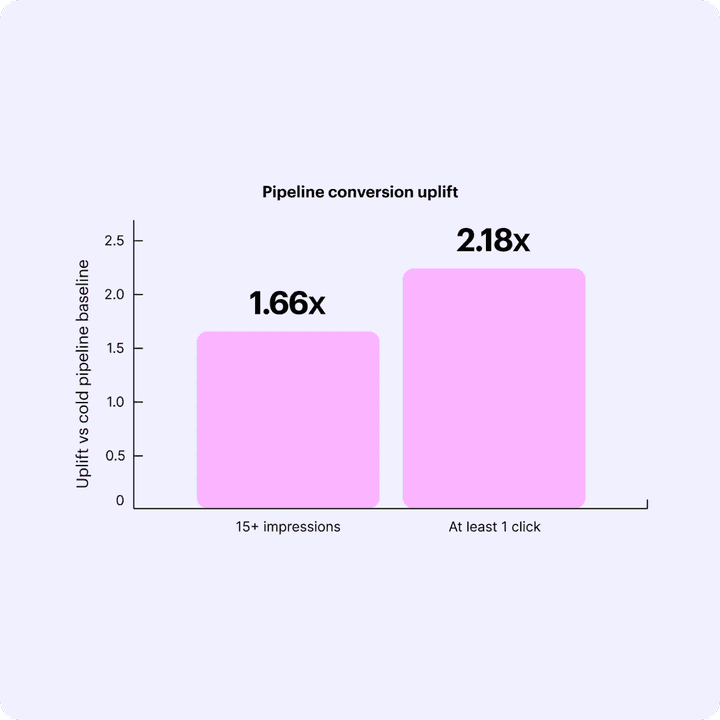
Influ2's Revenue Reporting counts an opportunity as influenced when at least one buying group member had meaningful ad engagement, defined as one click or 15+ impressions, then shows the pipeline generated, progressed, and closed for that group.
Compare the conversion rate of that influenced pipeline against your cold pipeline (the buying groups who weren’t shown ads), and the lift is the proof.
We've tested this across millions of targeted contacts and found that when buying group members had consistent ad exposure (15+ impressions) pipeline conversion was 1.66x higher than an audience with no ad exposure. And when they showed active engagement (at least one click), pipeline conversion was 2.18x higher.
Tom Gatten, founder of Adzact, arrived at the same conclusion.
What is the delta in close rate between accounts that had X paid impressions and accounts that had none? It's correlation, not causation, but it's honest.
When you can run that comparison, the budget conversation changes. Bonterra implemented contact-level ads and reported a 2x higher win rate versus cold outreach and 907% ROI, with 80% of the buying committee reached.
Unfortunately, teams are still struggling to get this level of granularity from their data. According to Influ2 and Forrester research, only 31% of ABM teams track total influenced revenue at all, which means most programs aren’t reporting on their strongest proof point (oftentimes because they don’t have the data).
The question that actually decides the budget
When you’re targeting mid-market and enterprise accounts with big buying committees, “who” becomes increasingly important. Can your ABM platform name the exact people it claims to have influenced?
If it can't, you have a blind spot that needs to be addressed, unless you want your program and budget put under a microscope every quarter.
Influ2 gives you the data you need to finally show who your program is reaching and tie that to revenue. Want to see how it works? Book a demo today!

Dominique Jackson is a Content Marketer Manager at Influ2. Over the past 10 years, he has worked with startups and enterprise B2B SaaS companies to boost pipeline and revenue through strategic content initiatives.

