4 Costly ABM Problems Contact-Level Orchestration Fixes


Account-based marketing was supposed to make go-to-market more focused, relevant, and effective.
And in some ways, it did. Teams got clearer on which accounts mattered, messaging became more targeted, and campaigns were easier to coordinate across channels.
But over time, something became very clear.
Legacy ABM platforms oversimplified how buying actually works.
They turned groups of very different people into a single account, rolled individual behaviors into aggregate signals, and treated the buying journey as something that could be completely standardized and automated.
Sure, it made ABM easier to run. But the account-level view widened the lens so much that the actual people you need to influence fell out of focus.
Unfortunately, a lot of teams still operate this way because it’s how traditional ABM tools are designed to work.
But staying stuck in that system comes at a cost.
Here are four issues that pop up when ABM is designed around accounts instead of individuals, and how contact-level orchestration puts people back in focus.
Problem #1: Journeys collapse into averages
The problem
Buyer journeys should help you understand where people are in their decision-making process, so Sales and Marketing know what to do next.
But in most ABM tools, journeys don’t progress based on individual actions. They move when an account stacks up enough activity to reach a specific account score.
That creates a delay.
One person might click an ad, search for a bottom-of-funnel keyword, or read a relevant article, but your ABM tool shows the account in the same stage because it doesn’t think they’re likely to convert right now.
Meanwhile, your messaging stays the same, and Sales misses an opportunity to capitalize on momentum while it’s happening.
It’s kind of like how the first fire detection systems relied on fixed-temperature heat detectors. Instead of triggering at the first sign of smoke, they activated after the air reached a high enough temperature. By the time the alarm went off, the fire already had time to grow.
Account-based journeys work the same way. Individual buyers can be active—clicking, searching, reading—but your ABM tool doesn’t “activate” until enough activity accumulates to cross a threshold.
Why this hurts GTM teams
The delay between when buyers show interest and when your ABM tool deems them worth reaching out to reshapes what buyers experience and how Marketing and Sales behave.
- Marketing keeps showing stage-based messaging that’s behind the buyer. A person could show signs of interest, but if the account hasn’t “moved” yet, they’re still served early-stage messaging.
- Sales gets alerted too late to act while the buyer is in motion. They’re reaching out after their interest has peaked, not while it’s building.
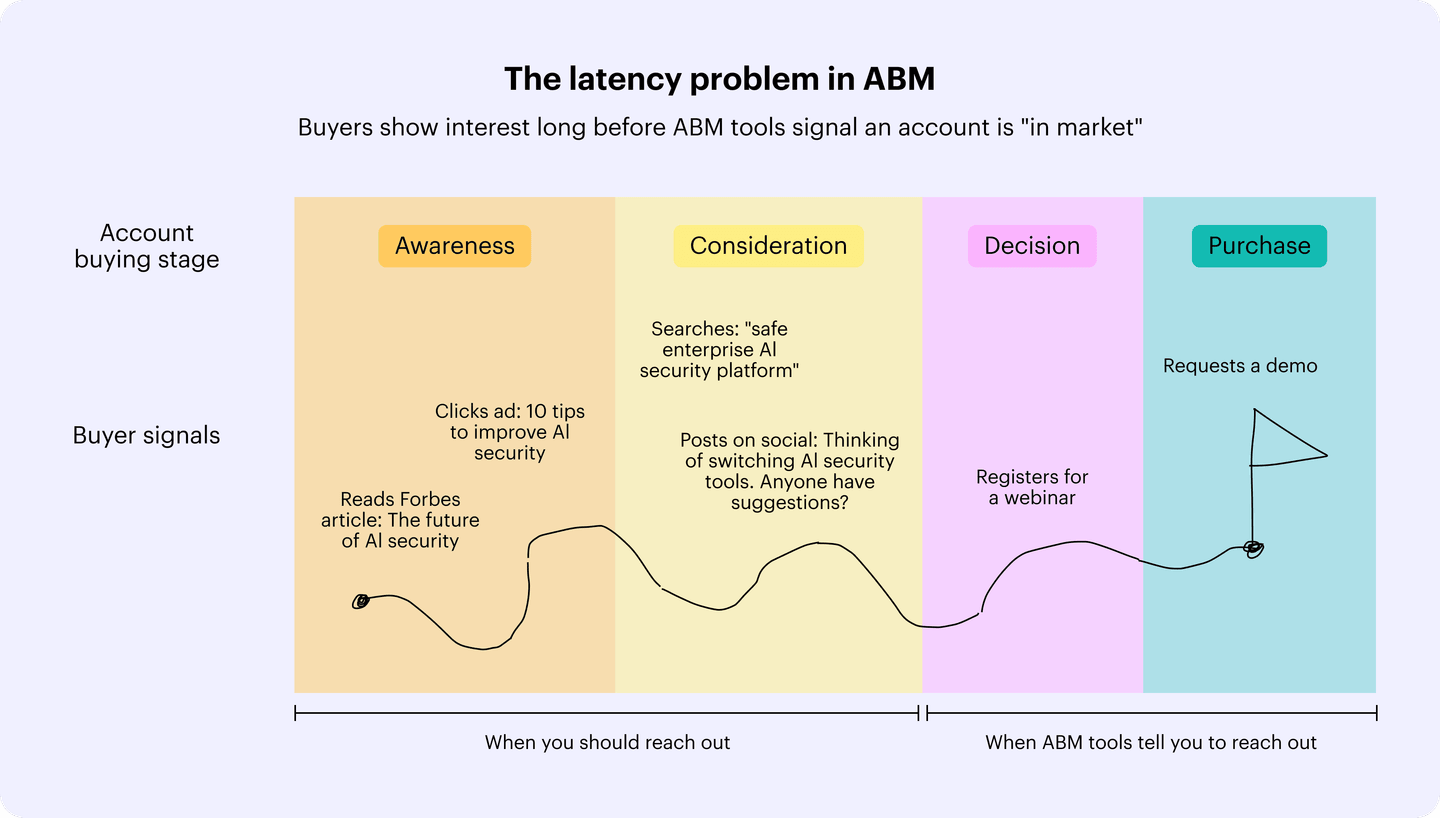
Over time, this creates a weird disconnect where buyers are moving forward, but your GTM motion lags behind them.
How contact-level orchestration helps
Contact-level orchestration removes the delay.
Instead of waiting for activity to accumulate at the account level, you can respond to individual behavior as it happens.
- Marketing can align messaging to the buyer’s behavior and interest in the moment.
- Sales can act while momentum is still building.
It’s the difference between telling you, “hey, your house is on fire,” and “we’re sensing some smoke, do something before it becomes a fire.”
Problem #2: Signals lose their meaning
The problem
If someone searches a high-intent keyword, clicks your ads, or engages with a relevant topic, that behavior should help you understand what they care about and what to do next.
Unfortunately, that’s not the case for a lot of GTM teams due to limitations of their ABM tools.
As Amanda Heredia, founder of ABX Stack points out:
Most of the tools we’ve had to date stop at the account. They tell you an organization is “surging” on a topic, but not who is actually behind the research.
Why this hurts GTM teams
When signals aren’t tied to a person, Sales and Marketing are left guessing.
- Marketing sees engagement, but doesn’t know which topic resonated with each person.
- Sales sees a signal but doesn’t know who to reach out to or what to say.
So instead of acting on insight, you’re forced to act on probability. And the larger the companies you’re targeting, the riskier that becomes.
For instance, say you’re selling digital marketing software to Atlassian. They have over 15,000 employees worldwide, including over 1,000 in marketing alone.
Even if you’re able to map signals to a department or role, there’s still a lot of overlap.
You won’t know which growth marketer clicked an ad for your case study about measuring campaign performance vs the person who searched “how to get more leads”.
Both are showing relevant signals, but without knowing who did what, you’re playing a guessing game.
How contact-level orchestration helps
When you orchestrate your ABM program at the contact level, every signal is tied to a specific person, topic, and action.
Before an SDR/BDR reaches out, they know what’s top of mind for each prospect based on their signals—what they posted on social media, read on another website, searched, or which of your ads they clicked.
On top of that, you can use signals to see how your buyers’ interests and priorities change over time. For instance:
- When a champion moves from high-level education to comparing you to a competitor
- When a technical stakeholder starts researching integration details
- When a decision-maker starts clicking ads about your product’s ROI
That’s all context you can string together to decide what Marketing and Sales should do next.
According to data from Salesforce, how well you adapt to those changes can make or break a deal.
Their data showed that “65% of customers expect companies to adapt to their changing needs and preferences, but 61% of customers say most companies treat them as a number.”
Problem #3: Personalization becomes pretend
The problem
AI has made it easy for marketing and sales touchpoints to look personalized through custom landing pages, industry-specific messaging, and a few dynamic fields filled in automatically.
But there’s a difference between messaging that was meant for “someone like you” versus messaging meant “for you”.
Too many GTM teams are doing the former, while buyers are craving the latter.
According to a Forrester study commissioned by Adobe, 59% of B2B buyers expect fully or mostly personalized content when researching and exploring a company’s product. That number jumps to 71% when they start engaging directly with you.
The challenge is that most ABM tools are built to reach and engage accounts rather than connect with and influence specific people, so you get surface-level personalization.
Why this hurts GTM teams
When you personalize your messaging based on aggregated account data or scraped data from a database, it creates the illusion of personalization, but not the experience of it.
And your buyers notice the difference.
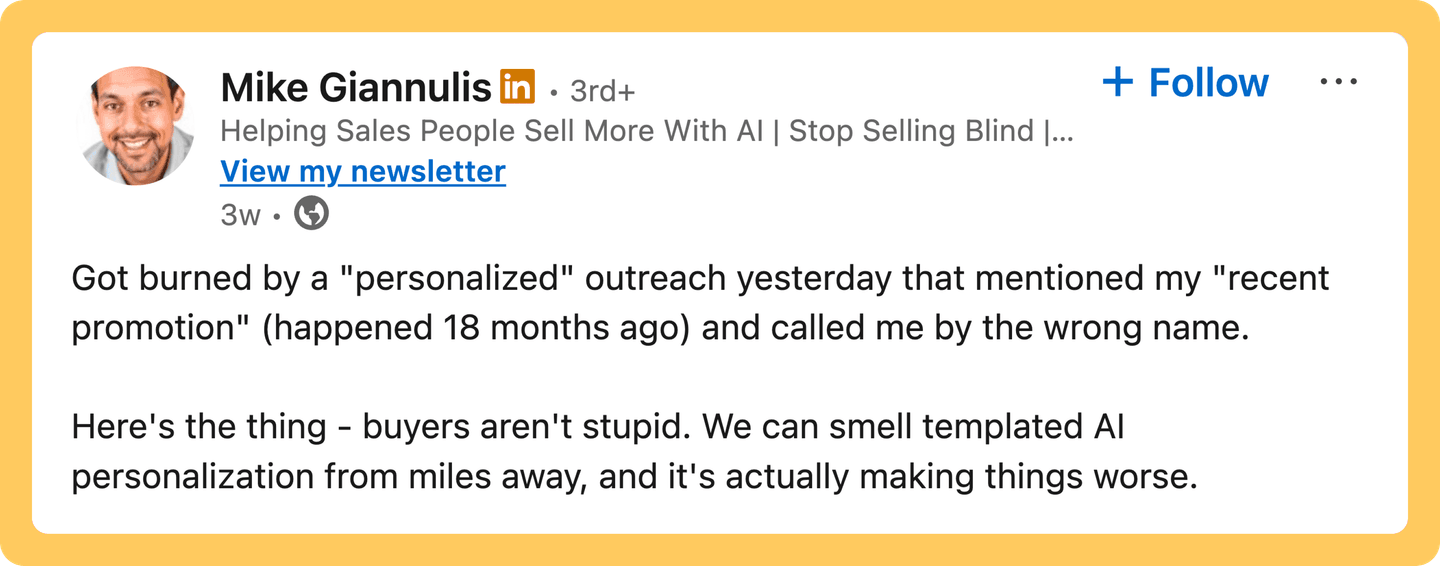
Here’s how that plays out for marketing and sales:
- Marketing campaigns look personalized on the surface, but they don’t reflect what each person actually cares about right now.
- Sales outreach gets ignored because it’s based on broad assumptions and generalizations instead of individual behavior.
Eventually, that all piles up and turns people away. A Gartner survey found that 73% of B2B buyers avoid vendors who send irrelevant outreach.
How contact-level orchestration helps
When buyers say they want personalization, what they’re really talking about is relevance. Hans Dekker, Head of Outbound Education at Instantly.ai, has seen the same pattern across millions of outbound emails.
What actually drives replies is relevance. If your offer solves a problem I care about today... If your message is simple and makes me think ‘yep, this matters to me…’ You’ll get a response.
To solve for that, contact-level orchestration changes what personalization is built on. Instead of personalizing solely on industry, company size, and titles, you base it on contact-level activity and signals.
All of those other criteria still play a part, but your outreach and marketing messaging are rooted in each person’s interests and behavior.
Here’s an example.
Say you’re targeting marketers at fintech companies.
With traditional ABM tools, you can create general ads, landing pages, and outreach sequences that speak to all the ways your product serves fintech marketers. You don’t know which people are going to see what, or what they’ve already engaged with, so you have to keep it high-level.
But when you’re orchestrating at the contact-level, and a VP of marketing searches for “revenue attribution”, you have new information about them that you can use to make your interactions with them more relevant. Now, Sales can reach out specifically about how your product helps with attribution or share a case study, instead of sending a generic email.
Problem #4: Visibility gaps cause false claims
The problem
After a football game, both teams go back and “watch tape.” Regardless of whether they won or lost, they review game footage to understand what happened so they can do more of what worked and less of what didn’t.
Aside from looking at the big picture, like how well their offense and defense played, they’re zooming in and analyzing the details like, “when our receiver did X on this play, the defender did Y, which led to Z.” Then they make adjustments moving forward.
GTM teams should do the same for ABM deals, but unfortunately, most can’t.
The problem is that traditional ABM tools only give you surface-level reporting that shows outcomes, not the chain of touchpoints that caused them. It’s like seeing the final score of a game, but not the plays that led to it.
Why this hurts GTM teams
When you can’t see what shaped a deal, you start making assumptions.
You look at a closed-won opportunity and see that the account engaged with marketing before pipeline was created. So you credit attribution.
But you don’t actually know:
- Which stakeholder engaged
- What they engaged with
- How that engagement shaped the sales conversation
So you end up optimizing based on incomplete information.
How contact-level orchestration helps
Contact-level orchestration is the difference between:
“This deal was an outbound opportunity.”
And…
“These three stakeholders engaged with these topics before pipeline was created.”
Instead of abstract influence, you get traceable context.
- Marketing can show how engagement built momentum.
- Sales can see where their outreach played a role in the journey
- Leadership can understand which activities shaped the deal
Putting people back at the center of ABM
All four of these issues stem from the same root problem: ABM was built around accounts, not the people inside them.
Influ2 flips that.
With Influ2, you can target, engage, measure impact, and orchestrate at the contact level, so your ABM program reflects how buying actually happens.
If you’re ready to see what contact-level orchestration looks like in practice, let's talk.

Dominique Jackson is a Content Marketer Manager at Influ2. Over the past 10 years, he has worked with startups and enterprise B2B SaaS companies to boost pipeline and revenue through strategic content initiatives.

