ABM Personalization: 4-Step Framework


What is personalization, really?
For some marketers, it’s a first name in an email. For others, it’s a highly targeted campaign built with just a few key decision-makers in mind.
How you define personalization depends entirely on the tools in your tool kit—and at Influ2, we have a pretty comprehensive tool kit.
Because of that, we’ve spent a lot of time thinking about what effective ABM personalization can (and should) look like, and we’ve come up with a four-layer framework that informs our approach to contact-level personalization.
ABM personalization happens in layers
All sorts of things come together to give each buyer a unique outlook.
Here’s an example: You target two marketers, both working in financial services organizations. There’s a lot of overlap there. You could easily send them the same campaign, and it would still be relevant.
There’s just one problem—one is on the verge of making a decision, while the other is just getting to know you. For every similarity they share, there’s an equally important difference.
That’s what we mean when we say personalization happens in layers. It accounts for the full range of individual variance, including:
- Audience cohort
- Buyer persona
- Sales context
- Engagement
Each of these aspects tells you something different about a buyer’s perspective and intent. By combining them, you can layer context atop context to build campaigns that feel 1:1, even when they’re done at scale using Influ2’s Custom Buyer Journeys.
It starts with the first of four layers of ABM personalization:
1. Divide your audience into cohorts
Every company has an audience. When we think about our audience, we think about all of the decision-makers who could potentially get value from Influ2.
Within that audience are sub-groups—we call them cohorts—that share a common set of characteristics.
Let’s say your audience is composed primarily of enablement teams. Within that audience, you could slice and dice it into any number of cohorts:
- Enablement teams based in Germany
- Enablement teams currently using one of your competitors
- Enablement teams attending an event you’re hosting next Thursday
- Enablement teams that still haven’t RSVPed to your event next Thursday
- And so on
This first layer of ABM personalization establishes basic relevance. It’s how organizations like Bonterra use Influ2 to build cohort-based campaigns that target specific groups, like event attendees.
I’m going all-in on using Influ2 for events this year. We target attendee lists to boost awareness, get people to our booth, and ultimately generate more pipeline.
Cohort-based ABM personalization is the foundation for everything that follows. It shows you know something about who your buyers are and prevents awkward mismatches, like messaging meant for the U.S. market landing on the screen of a team based in Europe.
But Influ2 lets you take it a step further.
Pro tip: Check out Influ2's Cohort Builder to get better control over who your ads target.
2. Drill down further into persona
When you have a buying committee that’s 15+ decision-makers strong, cohorts alone won’t cut it. Within a single committee, you might be dealing with:
- Six marketers (including one senior leader)
- Three IT professionals
- Four procurement specialists
- Two sales champions
That’s four different personas (and four different sets of priorities, objections, and perspectives) to address. They may share the same cohort, but that’s where the similarities end.
This is where the second layer of ABM personalization enters the picture.
For companies like One Door that face anywhere from 15-20 stakeholders in a single deal, persona-based personalization is essential, and Influ2’s contact-level ads make it easy.
Without a contact-level approach, everyone in an account might receive the same exact message and value prop—which isn’t great when IT and procurement are the #1 and #2 most common blockers in deals.
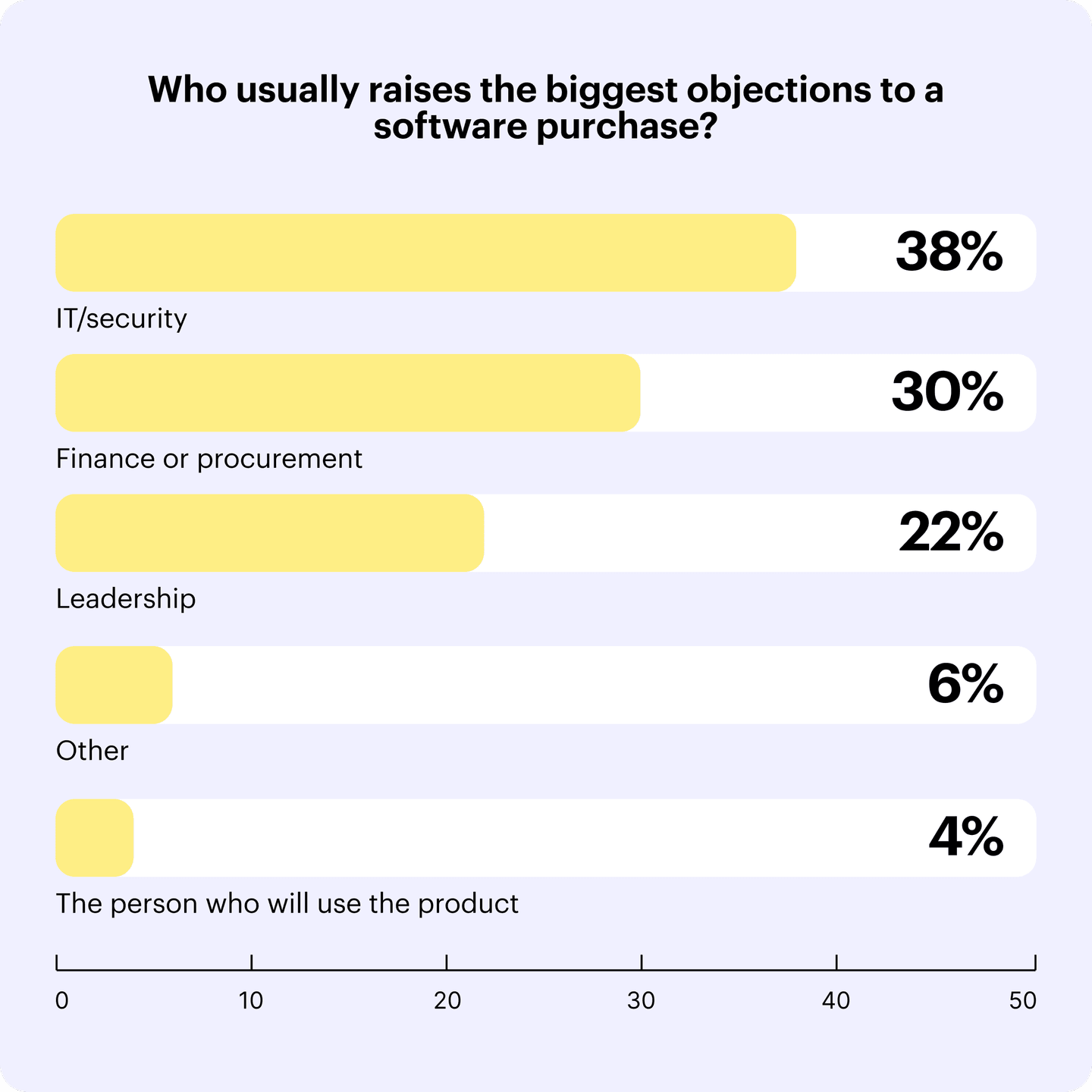
When we build personas into our campaigns, each decision-maker hears what matters most to them:
- Marketers hear how contact-level ABM can drive up to a 118% lift in pipeline conversion
- Finance learns how Bonterra doubled win rate using Influ2
- IT hears all of the security and compliance magic words
Come decision time, everyone is aligned and informed,
How can it get more relevant than that?
3. Weave in sales context
The third layer of ABM personalization incorporates sales context, including where a decision-maker is in their journey.
Your CRM has a great deal of information about your decision-makers—like whether they’re still in discovery or approaching a decision. We use that sales stage information to personalize even further.
As buyers move forward, they automatically move through custom journeys mapped out in Influ2 that align not just to their cohort and persona, but also to their stage in the decision-making process.
Why does this matter?
Because buyers still figuring out what you do aren’t in the market for case studies. They’re hungry for a tidy explanation of your capabilities without the B2B jargon.
And because late-stage buyers on the cusp of a decision don’t need another introduction—they just need reassurance they’re making the right choice.
Marketbridge, for example, uses Influ2 to deliver stage-based personalization during three key moments:
- Awareness: When buyers are building familiarity
- Consideration: When they’re evaluating capabilities and fit
- Decision: When they’re asking, “Will this achieve what I expect?”
We design campaigns around specific personas and adapt the ad journey based on how each person engages over time. It’s just like a nurture stream—but with ads.
The previous layers created the right message. This one ensures it arrives at the right moment.
And that leaves just one layer left.
4. Move forward with engagement data
The fourth and final layer of ABM personalization is guided by buyer behavior—what it tells us about them and how we act on that information.
Here’s an example: To support an active deal, you sent three or four different ad creatives to a CMO at a mid-sized tech company.
Of those, just one resonated.
She paused to engage with it, when she hadn’t shown interest before.
That brief moment of engagement tells you a lot:
- Marketing knows what to focus on
- Sales has the context to reach out in the right way
At this stage, decision-makers know who you are—and you know what interests them.
Teams like Quantexa use Influ2’s contact-level ads to warm up prospects, then rely on the signals from that ad engagement to reach buyers at just the right time—an approach that resulted in a 4.53x higher conversion rate and a 5.2x boost in pipeline.
And it has everything to do with insight. Using it, Quantexa’s sales team can see the exact ad that made a decision-maker stop scrolling and look closer.
Influ2 has transformed how we connect with prospects—it's not just about impressions; it’s about meaningful engagement that drives results.
Contact-level ABM treats buyers like people, not roles or titles
Every team handles personalization differently. But this is what works for us.
Over the years, we’ve found that the right message at the right time is less likely to go overlooked. When an ad is relevant enough, curious decision-makers just might click it—and when they do, we have a 2.18x better chance of converting them into pipeline.
These four layers are the key to the right message and right time. They’re our formula for campaigns that feel 1:1 but, for the sanity of our marketers, are much easier to manage.
Whether you adopt this framework or not, what matters is that you recognize that personalization should resonate on multiple levels.
Your decision-makers are more than their industry or their job title. If you can meet them with the right message, at the right time, and in the right context, you’re miles ahead of the competition.
Does your ABM program need a personal touch? Let’s talk.

Dominique Jackson is a Content Marketer Manager at Influ2. Over the past 10 years, he has worked with startups and enterprise B2B SaaS companies to boost pipeline and revenue through strategic content initiatives.

